
Clare Inmate Release Date Meanings
Michigan does not use one public field called a projected release appointment. For a state prisoner, OTIS displays the labels Earliest Release Date and Maximum Discharge. The first is generally the minimum-term point when the Michigan Parole Board obtains jurisdiction. It does not order the person released that day. The Board can grant parole at that point or later, depending on the law and the individual case.
Maximum Discharge is the sentence-expiration endpoint if parole does not happen first. Another active sentence, detainer, or custodial authority can still prevent community release. Date Paroled is retrospective. MDOC defines it as the date the person left a prison or camp or reached parole status from nonsecure supervision. Parole continues the sentence under supervision. A discharge entry marks the end of MDOC authority over that record.
| Official field | What it establishes | What it does not establish |
|---|---|---|
| Earliest Release Date | When Parole Board jurisdiction generally begins | A guaranteed departure date |
| Maximum Discharge | Sentence-expiration point under that MDOC sentence | Freedom from every hold or sentence |
| Date Paroled | Actual transition from prison or camp to parole status | Completion of supervision |
| Discharge | End of MDOC jurisdiction on the record | A county-jail release timestamp |
Find a Clare Inmate Release Date
The correct search depends on who holds the person. OTIS does not include people who served only a Clare County Jail sentence. The jail and local court own that path. OTIS covers prisoners, parolees, and probationers under MDOC, plus people discharged within the public post-discharge window described by MDOC. A federal or immigration custody record requires a different locator.
- Confirm whether the person is in Clare County Jail, an MDOC prison, or another custody system.
- For MDOC, open OTIS and search by MDOC number when possible. Otherwise use the name and compare identity and sentence details.
- Copy the labels exactly: Earliest Release Date, Maximum Discharge, Date Paroled, discharge status, and current location.
- Read status with the date. A future eligibility date beside “Prisoner” does not show release.
- For a Clare County Jail sentence, obtain the Judgment of Sentence from the appropriate court and ask the jail for the actual release record.
- When dates conflict, contact the sentencing court for a court-derived error or MDOC Records Retention for the state computation.
The official MDOC frequently asked questions explain the public release-date fields and OTIS limits. The manifest image below preserves that state source.
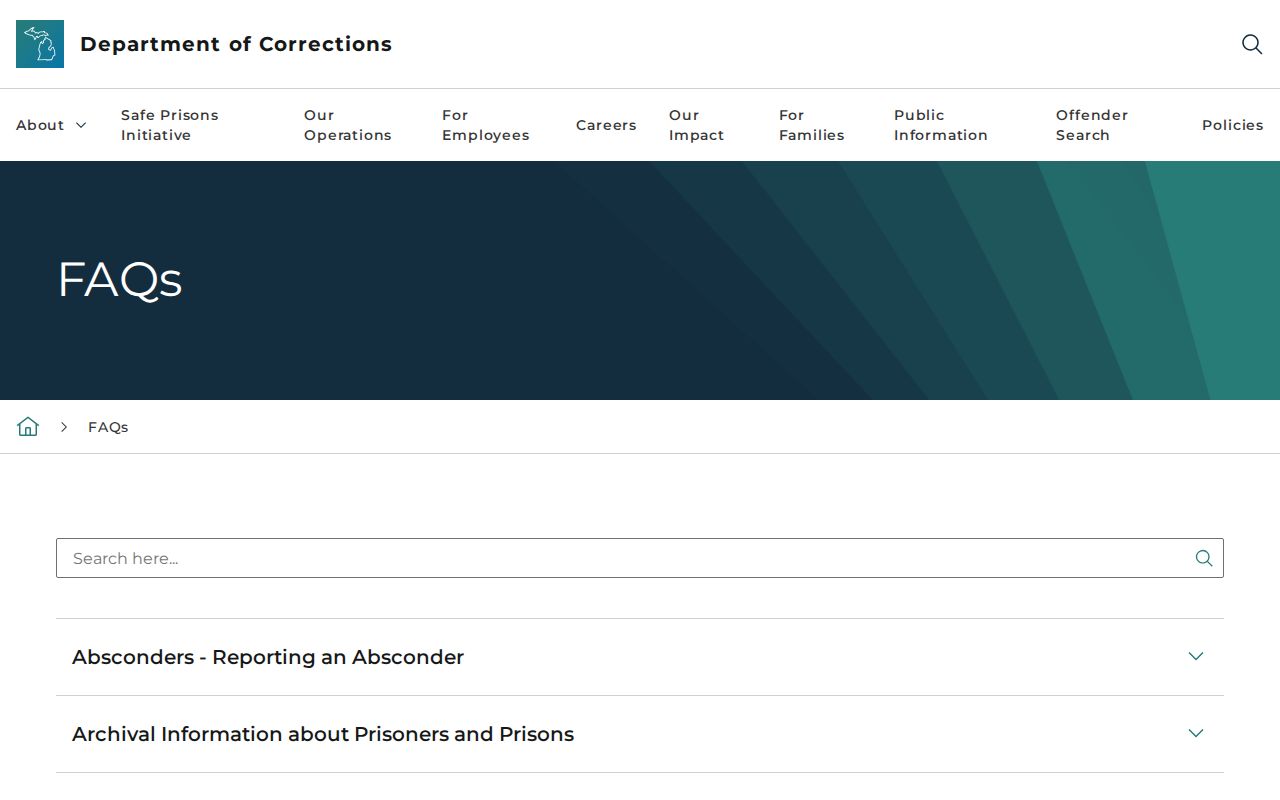
The FAQ helps interpret a state sentence date, but it cannot calculate a jail-only release or replace a specific court order.
Michigan Truth in Sentencing Dates
Michigan truth in sentencing is not the federal 85-percent shorthand. MCL 791.233b establishes disciplinary time and, for covered modern offenses, bars parole eligibility until the judicial minimum term has been served. The scheme phased in for specified offenses committed on or after December 15, 1998 and for all crimes committed on or after December 15, 2000.
For a modern offense governed by disciplinary time, a prisoner generally serves 100 percent of the minimum term before parole eligibility. That does not require 100 percent of the maximum in every case. It also does not force the Board to release the person on the minimum date. The minimum opens the Board’s jurisdiction under the applicable rules; the parole decision and practical release processing come later.
MCL 791.234 addresses Board jurisdiction and special categories, including consecutive sentences and some life terms. The statute has exceptions and exclusions. No single percentage or hand calculation can safely replace the Judgment of Sentence, offense date, and MDOC computation.
The legislative source image comes from Michigan’s parole-jurisdiction statute.
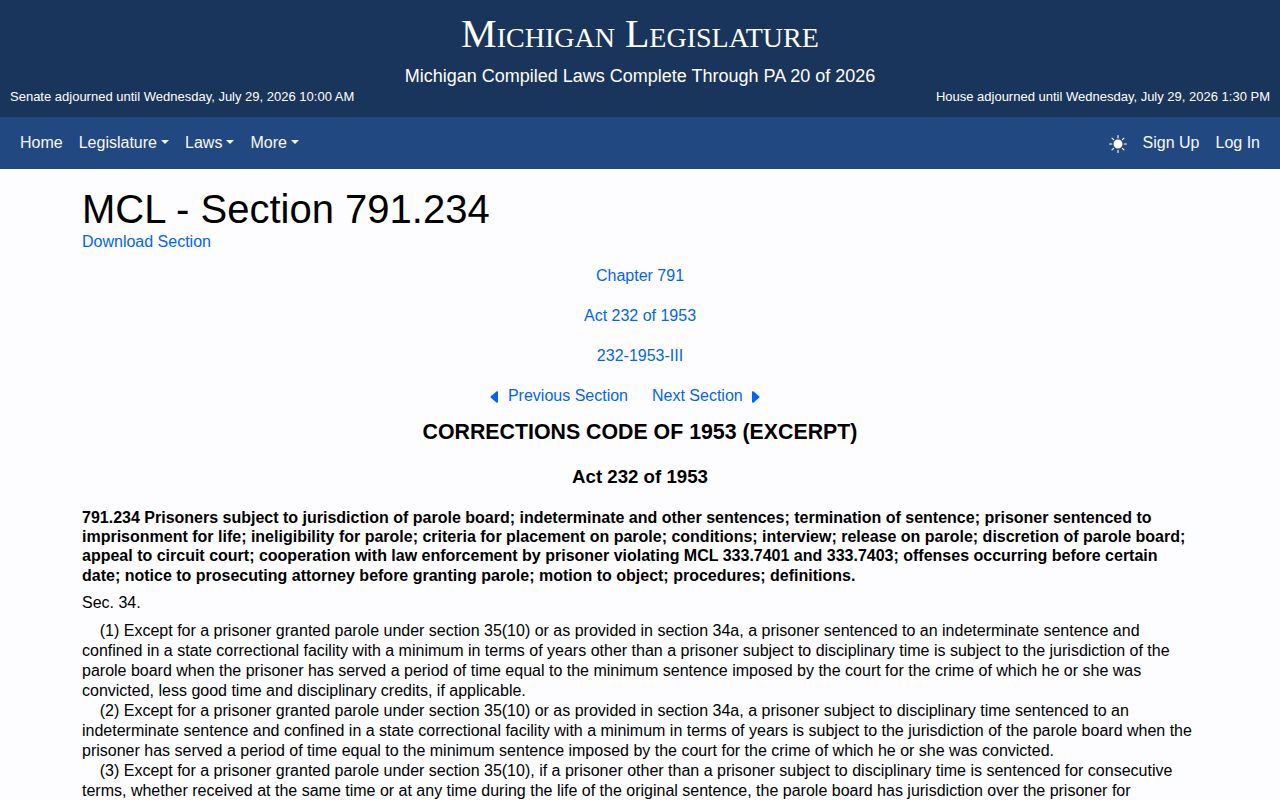
It supports the legal framework, while OTIS supplies the dates calculated for a particular MDOC record.
Clare Release Credits by Offense Date
Good-time and disciplinary-credit rules are offense-date and sentence specific. MCL 800.33 governs good time or disciplinary credits for eligible classes, including rules on forfeiture and restoration. Some older cases may remain credit eligible because the law in effect for the offense controls. It is inaccurate to state that every Michigan prisoner either gets good time or never gets any credit.
OTIS reflects MDOC’s sentence computation. It is not a public calculator that can be rebuilt from the maximum term alone. A full calculation may depend on the minimum and maximum terms, offense date, jail credit, concurrent or consecutive structure, credit rules, amended orders, other sentences, and the Parole Board’s decision after eligibility.
The statute screenshot is tied to the official MCL 800.33 source.
The law shows why an offense date matters, but MDOC or the sentencing court must resolve a person-specific computation dispute.
Why Clare Release Dates Change
A date can move when the legal inputs change or when the first field was misunderstood. A corrected sentence or recalculated jail credit may alter an OTIS date. The loss or restoration of an eligible credit can matter in an older case. A new court order, appellate result, or amended judgment can change the underlying sentence. Even a favorable parole decision may require placement and release processing before physical departure.
Jail credit is one important input. It accounts for qualifying time spent in custody before the prison sentence when the court and law recognize that credit. It is not the same as parole, good time, or a promise of immediate release. Consecutive sentences also differ from concurrent sentences. Concurrent terms run at the same time to the extent ordered, while consecutive terms run one after another. The Judgment of Sentence and MDOC computation are needed to see how those rules apply to one record.
| Factor | Possible effect | Best confirmation |
|---|---|---|
| Sentence correction | Minimum, maximum, or credit can be recalculated | Sentencing court and updated OTIS record |
| Offense-date credit law | Eligible credit may be earned, lost, forfeited, or restored | MDOC computation and applicable statute |
| Concurrent or consecutive terms | Multiple sentences change when Board jurisdiction or discharge occurs | Judgment of Sentence and MDOC |
| Other hold or detainer | Leaving MDOC may mean transfer, not community release | Holding and receiving agencies |
| Parole decision | Release may occur after eligibility, subject to processing | OTIS, Board record, and Date Paroled |
Save the OTIS date and the date it was accessed. Compare it with the Judgment of Sentence. When the two conflict, ask MDOC Records Retention or the court rather than predicting which value will control.
A hold or detainer requires special care. A detainer is notice that another authority may claim custody. The person can reach an MDOC release point and still transfer to a county, federal, or immigration agency. In that case, Date Paroled or discharge can answer what happened to the state sentence without proving community release. Confirm the receiving agency before arranging transportation or treating the state date as the end of all custody.
Clare County Jail Release Dates
Clare County Jail sentences follow a different record path. No official Clare source publishes a local good-time policy, release calculator, weekend or holiday adjustment, or staff processing rule. MDOC’s Earliest Release Date must not be applied to a person sentenced only to the county jail. Obtain the sentence or order, then use the Clare County FOIA form to seek the actual release record.
A pretrial detainee has no sentence-end date. Bond may authorize release, but the person must satisfy the bond terms, complete jail processing, and have no other hold. A time-served ruling can authorize release in one case while another case or agency keeps the person confined. A court order supplies the legal authority; the jail record supplies the physical departure date and recorded release type or destination.
The local court path also depends on the case stage. The 80th District Court handles misdemeanors and the early stages of felony cases. A felony that is bound over moves to the 55th Circuit Court for its lasting disposition and prison sentence. Search the correct case for bond events, judgment, sentence, and later orders. A sentencing date or closed-case label still does not state when the person crossed the jail threshold. Pair the court file with the jail release entry.
Clare County Jail
255 West Main Street
Harrison, MI 48625
(989) 539-7166
Control room extension 4238
Records/front office extension 4220
For documentary proof, ask for the booking and release entry with actual release date and time, disposition code, destination or receiving agency, and the related court order. Clare County does not publish an official recent-release archive. A missing online name is not a release date.
Confirm a Clare Release Event
For a past state-prison departure, prioritize Date Paroled, a discharge certificate, or another actual MDOC status entry. For a county-jail departure, prioritize the jail release record and then compare the local court disposition. When another agency takes custody, the person has left the named facility but has not necessarily entered the community.
For a formal state record, MDOC may provide a release package often called a PENPACK. Depending on the available and disclosable record, it can include sentence and parole documents, an offender photograph, fingerprints, the Judgment of Sentence, and a Discharge Certificate. That package serves a different need from a quick OTIS check. OTIS is useful for current public fields; the formal record is the better route when a certified or older sentence history is required.
A VINELink alert can help with a new custody change, but notification timing is not guaranteed. Registration and limits are covered in the VINELink Release Check. Direct confirmation remains important when exact timing affects a pickup, court process, or personal safety plan.
Older MDOC cases may not appear in public OTIS more than three years after supervision discharge. MDOC Records Retention can provide older discharge materials. An expunged or set-aside record may also become nonpublic. No result should be translated into a release, discharge, or lack of custody history.
If an OTIS value appears wrong, route the issue to the office that created it. Most conviction and sentence information originates with the court, so the sentencing court should review a court-derived error. MDOC lists correctionsinfo@michigan.gov for inaccurate, outdated, or incomplete corrections information and mdocwebmaster@michigan.gov for technical faults. For an older state record or a formal release package, MDOC Records Retention can supply the appropriate request path. A corrected source record is more useful than a saved screenshot of a value known to be wrong.
Note: Use the date label exactly as published, because eligibility, parole, discharge, and physical release answer different questions.
Public Record Search
Sponsored Results